

Optical Encoder
An Optical Encoder is an encoder using a light source, detector and interrupting medium to provide an output based on the speed and direction of the lines on that medium. Optical encoders can be transmissive—often with the light on one side of the medium and the detector on the other side or they can be reflective—the detector seeing the light reflected off of the patterned disk.
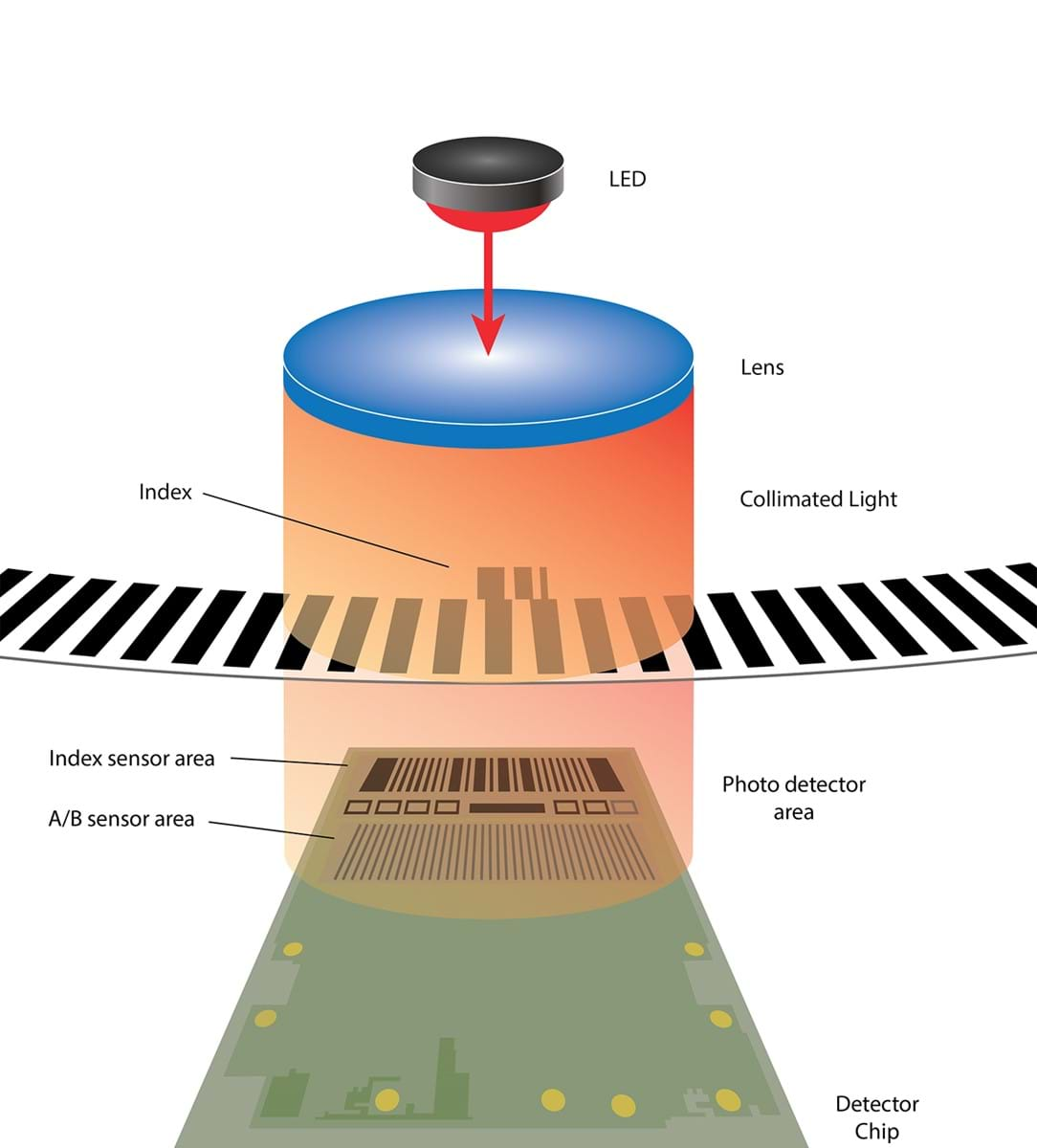
The interrupting medium is a disk for rotary encoders and a linear strip for linear encoders. The output is dependent on the quality of the pattern on the disk or strip. US Digital makes the code wheels for all of our encoders. The code wheel patterns are created using precision digital plotters and cut using a precision laser cutter. US Digital uses a highly collimated solid-state light source. Most of US Digital’s optical encoders are transmissive. The collimated light rays pass through the disk (or strip) pattern. The image of the pattern is detected using a phased array monolithic sensor and is converted to TTL digital quadrature outputs. Reflective type encoders (E4T / S4T) bounce the collimated light off a patterned reflective code wheel. This means all of the electronics are one side of the code wheel making for a more compact design. See Magnetic Encoder